If you've been seeing headlines about "a new European travel requirement" and quietly wondering what it means for your vacation plans, you're not alone. The ETIAS (European Travel Information and Authorization System) has been in the news for years, but the launch date keeps getting pushed back. But here's where things actually stand right now: it's coming, it's expected to launch in late 2026, and you'll want to understand it before you book your next trip to Paris, Rome, or Barcelona.
The good news? It's not a visa. It's not expensive. And it takes about ten minutes to apply. Here's everything you need to know.
What Is ETIAS, Exactly?
ETIAS stands for European Travel Information and Authorization System. Think of it as Europe's version of the U.S. ESTA, the travel authorization Americans already require for citizens of visa-exempt countries visiting the U.S. ETIAS is not a visa in the traditional sense. The application process is designed to be completed entirely online, without an in-person appointment.
ETIAS is an electronic screening system for passport holders who currently have visa-free access to the European Union and Schengen Area. It is designed for short-term visits of 90 days or less. Right now, Americans can walk off a plane in Europe with just a passport. Once ETIAS is in full effect, that changes — you'll need to secure your authorization before you depart.
The purpose of this new requirement is to strengthen border security in response to increased security concerns and to improve pre-arrival screening for all visitors. Europe is following a model already in use by the U.S., Canada, Australia, and the UK.
It's a ten-minute online form, not a consulate appointment.
When Does ETIAS Go Into Effect?
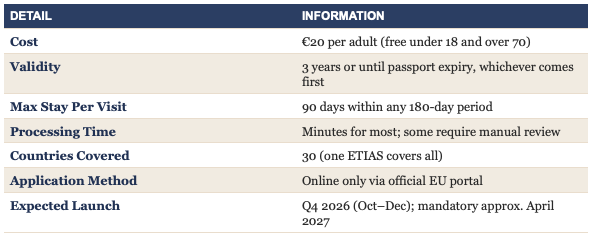
The system is scheduled to launch in Q4 2026 — meaning October through December. The EU has not announced a specific date and will communicate it several months before launch. ETIAS becomes mandatory approximately six months after launch, around April 2027.
Worth knowing: there will be a grace period when ETIAS first launches. During an initial transitional phase of at least six months, travelers will be encouraged to apply but will not be refused entry solely for lacking authorization. After both phases conclude, the authorization becomes mandatory for all qualifying travelers.
This also isn't Europe's first attempt at a launch timeline. The launch has been delayed multiple times — from 2021, to 2022, 2023, 2024, and 2025 — largely due to technical challenges with the Entry/Exit System (EES), which ETIAS depends on. The EES is now operational, which removes the biggest historical blocker. The Q4 2026 window is considered the most credible timeline to date, but the EU will confirm specifics closer to launch.
IMPORTANT NOTE:As of today, no action is required. The ETIAS application portal is not yet open. Any website currently accepting ETIAS applications is fraudulent. Only apply through the official EU portal at travel-europe.europa.eu/etias once it goes live.
Which Countries Require ETIAS?
Once ETIAS is in full effect, you'll need it to enter 30 European countries if you are visa-exempt. That covers the full Schengen Area plus a few additional countries. Here's the complete list:
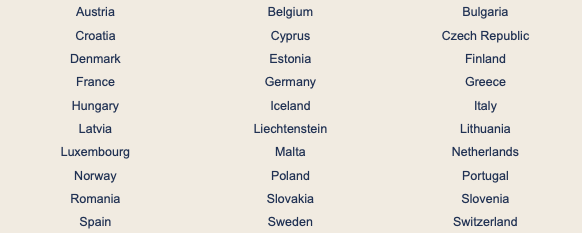
Ireland remains outside the ETIAS system. The UK has implemented its own separate Electronic Travel Authorization, which took effect on February 25, 2026, and must be obtained separately before traveling there. So if your itinerary includes both London and Paris, you're dealing with two different pre-travel systems.
Also worth noting: ETIAS is required even for transit. If you have a layover in an ETIAS country, authorization is mandatory. Without it, airlines may deny boarding.
Who Needs to Apply?
ETIAS applies to travelers from visa-exempt countries, including the U.S., UK, Canada, Australia, Japan, and many others. If you previously traveled visa-free to Europe, you will now need an ETIAS.
All travelers, regardless of age, will be required to obtain an ETIAS. That means one per person, including children.
There is one exception worth noting for dual citizens: dual citizens who hold passports to both an EU and an ETIAS-eligible country will not require an ETIAS if they enter and exit Europe using their EU passport.
How to Apply and When
The application portal isn't open yet, but here's exactly what to expect when it is.
- 1.Go to the official portal. The only legitimate place to apply will be travel-europe.europa.eu/etias once it opens in late 2026. Avoid any third-party sites.
- 2.Have your passport ready. To receive your authorization, you must provide a valid email address and ensure your passport is valid for at least three months past your planned travel dates.
- 3.Complete the online form. You'll fill out personal details, passport information, travel plans, and background questions related to health and security topics. The whole process takes about ten minutes.
- 4.Pay the fee. The fee is €20 for adults. Travelers under 18 and over 70 are exempt from the charge. Payment is by credit or debit card.
- 5.Receive your authorization. Most applications will be processed automatically within minutes. A small proportion may be referred for manual review, which can take longer.
One practical tip: even a small mistake, like entering the wrong passport number, can delay approval. Take your time and double-check your answers. And apply before your trip. This is not something you want to be scrambling to sort out at the airport.
What About Global Entry? Does That Help?
This is one of the most common questions I get from clients who travel internationally. If you have Global Entry, PreCheck, or any other U.S. Trusted Traveler Program, you're used to breezing through customs. So does any of that carry over to Europe?
Short answer: no. Trusted traveler programs like Global Entry and NEXUS offer no special privileges under ETIAS or the EU's Entry/Exit System. Europe, the U.S., and Canada all use digital travel systems, but none have fully reciprocal known-traveler benefits.
Global Entry is a U.S. program managed by Customs and Border Protection. Its job is to speed up your re-entry into the United States after international travel — full stop. It has no agreement with the European Union that exempts you from ETIAS. Everyone in a visa-exempt country applies, period.
That said, while the first EES enrollment may cause longer wait times at border crossings, later visits should be quicker — similar to how using Global Entry kiosks became seamless over time. Once you're in the EU's system, subsequent entries will go more smoothly.
THE BOTTOM LINE ON GLOBAL ENTRY + ETIASGlobal Entry handles your return to the U.S. ETIAS handles your entry into Europe. They're separate systems for separate purposes. You need both if you travel internationally and value smooth crossings. Neither replaces the other.
What You Should Do Right Now
There's no application to complete today. The portal isn't open. But there are a few things worth doing now so you're not caught off guard later.
First, check your passport expiration date. Your passport must have at least six months remaining before it expires when you complete your ETIAS application. If you're close to that window, renew before the ETIAS portal opens. Passport processing times have been unpredictable, so don't wait.
Second, bookmark the official EU site: travel-europe.europa.eu/etias. That's where the EU will post the confirmed launch date and where you'll apply. The EU has stated it will announce the specific start date several months before launch.
Third, if you have a European trip booked for late 2026 or early 2027, pay attention to the timing. Understanding the ETIAS requirements well in advance is essential for planning, especially for those booking travel for late 2026 or early 2027. The grace period means immediate enforcement won't hit on day one, but you don't want to be a last-minute applicant when the system is brand new and processing times are unknown.
~ Travel smart. Travel prepared. ~
The Big Picture
The ETIAS is a small administrative step with a big impact on how Americans plan their travel to Europe. But if you approach it the same way you'd approach renewing your passport or applying for your ESTA before a trip to the U.S., with a little lead time and the right information, it's genuinely not a burden.
It costs less than a good glass of wine in Paris. It lasts three years and covers 30 countries. And it can be done in the time it takes to watch a YouTube video.
The bigger thing to take away? Travel planning is getting more layered, not less. Pre-authorizations, biometric entry systems, and digital border checks are the new normal. Which is exactly why having a knowledgeable travel advisor in your corner matters more than ever. I keep track of these changes so you don't have to.
Have questions about how ETIAS affects a European trip you're planning? Reach out. That's what I'm here for.
Follow me on my socials, clicking theLINK.